Issue
Los Angeles: “Paul Pfeiffer: Prologue to the Story of the Birth of Freedom”
Paul Pfeiffer
Prologue to the Story of the Birth of Freedom
Museum of Contemporary Art, Los Angeles
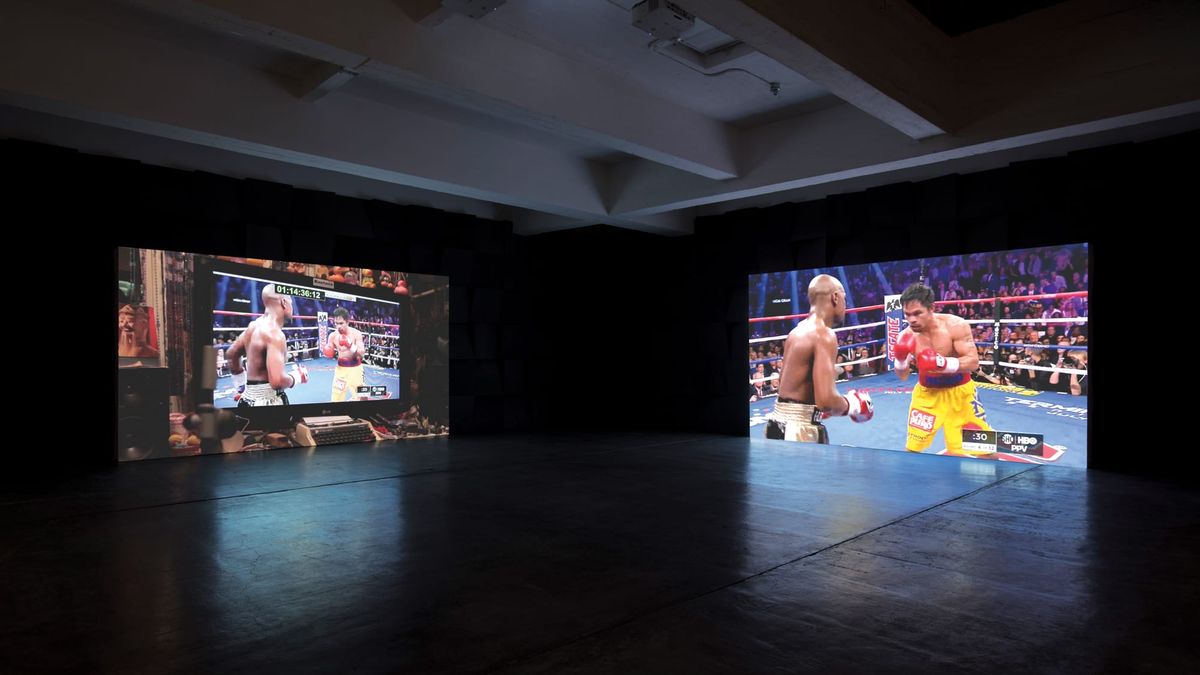
In an age in which we spend our waking hours looking at screens, Paul Pfeiffer’s midcareer retrospective of manipulated videos and photographs from the last 25 years felt eerily prescient and pertinent. Presenting digital videos on now-retro technology—CRT cube television monitors, LCD monitors, camcorder screens, portable DVD players, and projectors—Pfeiffer revealed the invisible forces of power, violence, and historical trauma using the techniques of image-editing software: looping, erasure, splicing. His gestures of recontextualization change the passive viewer into an active one, critically watching and reconsidering the media—and the ideas and structures they represent—that we surround ourselves with daily.
Spectacles of sporting events and popular culture are frequent subjects for Pfeiffer. The photographic series Four Horsemen of the Apocalypse (2000– ), named after the biblical personifications of death, famine, war, and conquest, depicts athletes such as professional basketball players in the decisive moment of triumph or agony with other players completely erased from the scene, highlighting their god- or superhero-like status. A set of sculptures that similarly reflects on the deification of popular culture stars, Incarnator (2018–23) presents santos (religious icons for the Catholic church) carved by wood artisans in the Philippines, Spain, and Mexico into forms modeled on tattooed pop musician Justin Bieber’s body parts. The segments of Bieber suggest that while we can build our celebrities up, we can just as easily break them down.