FROM THE ARCHIVE
Huang Yong Ping: Will It Return?
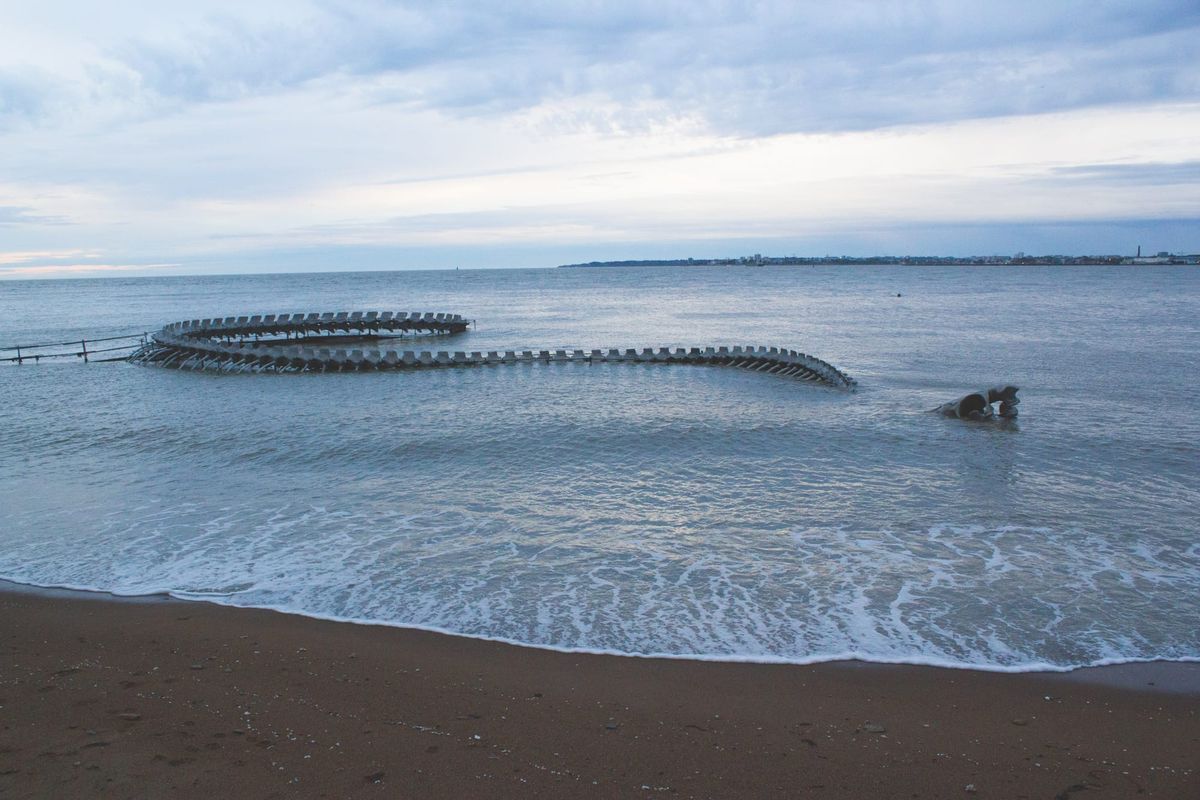
On Serpent d’Océan by Huang Yong Ping, or, a way to remember a master of our time.
There are very few contemporary artworks that have returned after their physical disappearance. Among these legendary works, Robert Smithson’s Spiral Jetty (1970), in the Great Salt Lake of Utah, is certainly the most famous, and remains shrouded in mystery. A spiral of stones and mud that was covered by water for decades, it is a monument of both utopia and dystopia, a testimony to the triumph of humans over nature and our capitulation to entropy. Half a century later, and across the Atlantic, Huang Yong Ping’s Serpent d’Océan (2012) resurrects the mystery of the return, while at the same time launching a new legend about the unstoppable power of entropy. In this case, the legend refers to both the natural world and human society. More precisely, this incarnation represents how entropic metamorphosis mingles with and transforms nature—including animals and humans—as civilization carries the planet into the Anthropocene era, leaving us speculating on what “post-human” means and what our future will bring.
Serpent d’Océan is an immense skeleton of a serpent, cast in aluminum and 130 meters long, its spindly ribs planted in the water near the beachhead of Saint-Brevin-les-Pins on the French coast. Obeying the rhythm of the tides, the gigantic snake is alternatively immersed in the Atlantic and reappears every few hours. As with the tide, it recedes and returns infinitely. When looking at the work, one can’t help but ask: Where does this serpent come from? Why is it here, at the estuary where the ocean merges with the Loire? Where will it go afterward? One obvious resemblance is to the figure of the migrant, whether human or animal, or a material thing. Over time, the snake’s “body,” or skeleton, is eroded while also growing a new skin of maritime species. Like a living fossil, it testifies to the formation of a new geological layer, albeit one applied to a human-made “animal.” And although it never existed as a real serpent with skin and flesh, with these processes of accumulation and abrasion, the skeleton now has its own life cycle.