Issue
Hong Kong: “Howie Tsui: The Cradle Rocks Above an Abyss”
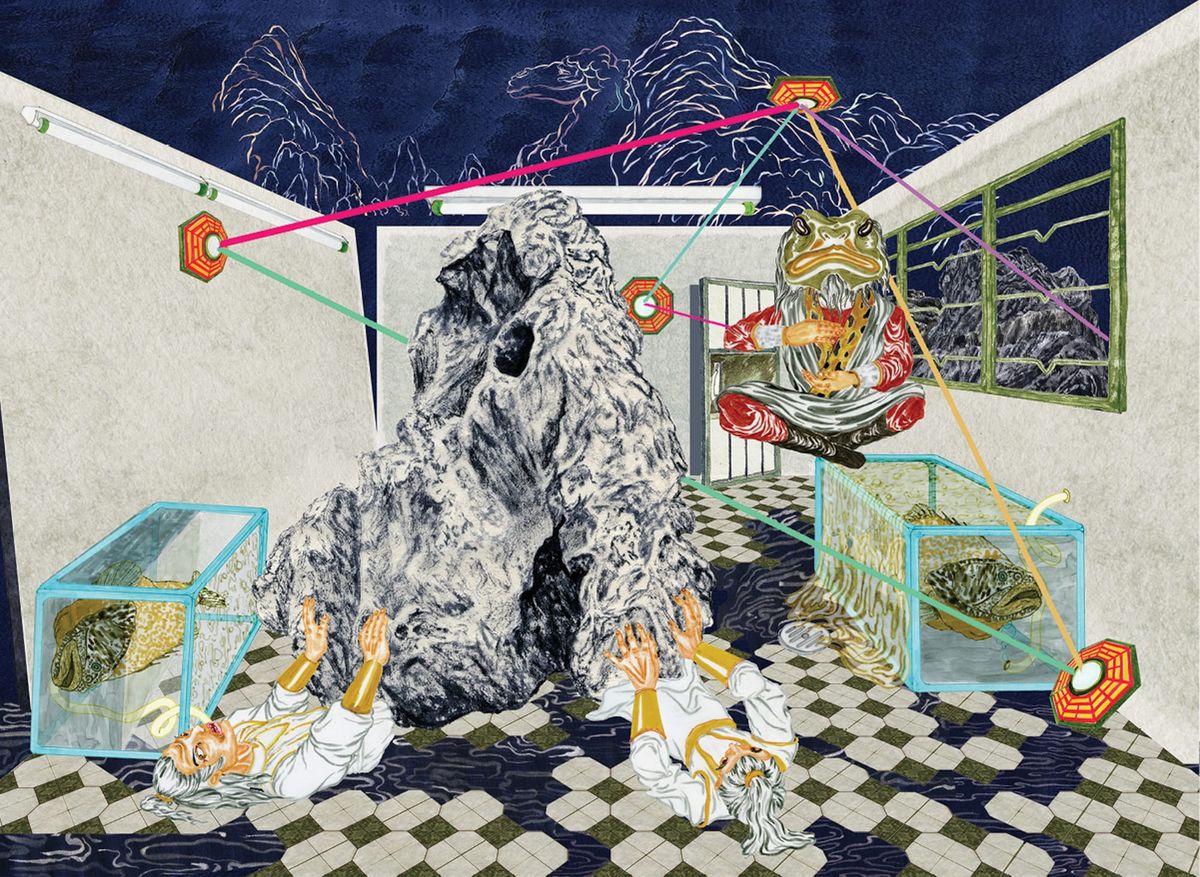
Howie Tsui
The Cradle Rocks Above an Abyss
Hanart TZ Gallery, Hong Kong
For his first solo exhibition in the city of his birth, Canadian-Hong Kong artist Howie Tsui presented a new series of mixed-media works featuring surreal characters and absurdist scenes, in large part inspired by his nostalgia for mid-20th century Chinese novelists and late-20th century screen and television writers working primarily within the wuxia (martial arts) genre.
In actuality, Tsui’s pigment and ink paintings reveal a wide range of cultural influences—from the Japanese pictorial tradition of ukiyo-e, Western surrealism, and Chinese painting, to Hong Kong television soap operas and martial arts classics. In Tsui’s large painting The Banquet (2023) a plethora of grotesque characters—baton-holding security guards with heads resembling mahjong tiles, a blindfolded woman playing the Chinese zither, a gongshi (Chinese decorative rocks in irregular shapes) in the form of an emperor, and a squatting spectator with the wings of a bat—appear as sci-fi-inspired reimaginations of the well-known Duke of Mount Deer (1984), a wuxia fiction adapted for Hong Kong television station TVB. While Tsui adroitly captures specific (and regional) collective memories, he also subverts them by reshaping and distorting their recognizable characters and features. Tsui further expanded the series to reference similarly iconic TVB scenes in paintings such as Lucky Abductions, An Umbral Abduction (pyromancers), and Radial Palms (all 2023). For Tsui, embracing these culturally coded subjects, especially for generations of Chinese immigrants like himself, is a subtle form of resistance against the forces of alienation, as well as the erasure of cultural or historical identity.